CASAFARI’s present all around France
Get to know the most desirable locations.
France’s residential real estate market has stabilised in 2026, recording 951,000 existing-home sales in the 12 months to August 2026 (+3.6% year-on-year, according to the Notaires de France Q2 2026 property market report) across a total population of 69.1 million inhabitants (INSEE, January 2026). Buyers navigating the market must budget 7% to 8% in resale closing costs while adhering to strict energy-rating rental bans, updated tourist-let tax allowances, and regional property wealth taxes.
Why is the French property market drawing international buyers and investors in 2026?
France continues to offer structural market stability, backed by high-quality transport infrastructure and steady international demand. High-speed TGV rail links seamlessly connect Paris to regional economic hubs like Lyon, Bordeaux, Marseille, and Lille, while Eurostar routes link Paris directly to London and Brussels. This connectivity ensures that both urban commercial centres and lifestyle regions remain accessible to international investors, private buyers, and cross-border professionals.
Demand remains distinct across key geographical sub-markets:
- Paris and Île-de-France: Valued for deep liquidity, institutional backing, and continuous tenant demand from multinational corporate headquarters.
- Provence-Alpes-Côte d’Azur: Coastal hotspots including Nice, Cannes, and Aix-en-Provence draw sustained international demand for secondary homes and lifestyle properties.
- Auvergne-Rhône-Alpes: Anchored by Lyon’s commercial sector and high alpine resort destinations, offering dual-season tenancy demand.
- Nouvelle-Aquitaine and Occitanie: Regional capitals such as Bordeaux, Biarritz, Toulouse, and Montpellier benefit from positive demographic inflows and expanding technology sectors.
Navigating French real estate requires an understanding of how local agencies operate. Estate agents in France frequently operate under non-exclusive mandates (mandats simples), meaning the exact same property is often advertised concurrently by multiple agencies, sometimes with conflicting information. Professional buyers and estate agents rely on CASAFARI Area Insights and Property Sourcing across deduplicated French listings to clean up duplicate listings and analyze true market supply across regions.
How does the buying process work in France and what do transactions cost?
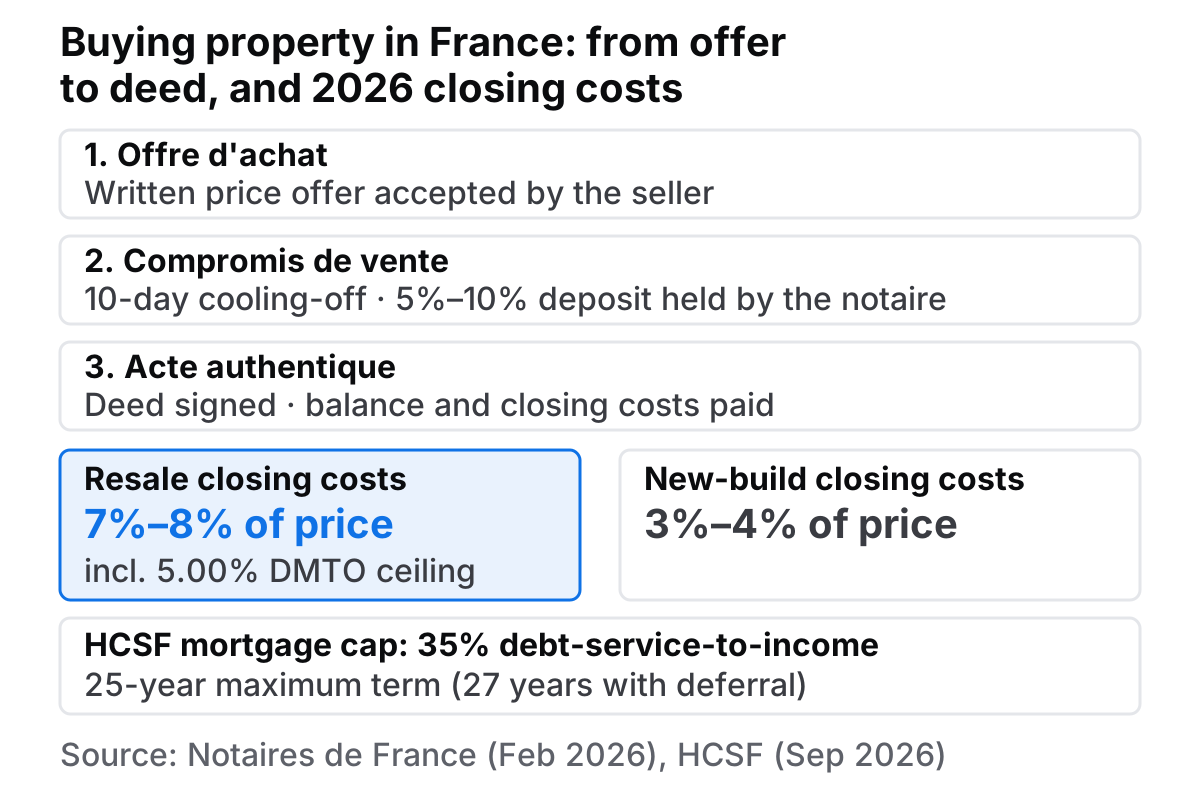
Property transactions in France are supervised by a public officer known as a notaire, who guarantees the legal validity of the transfer and collects state taxes. The purchasing process moves through three main legal milestones:
- Written Offer (Offre d’achat): A formal price offer submitted by the buyer. Once accepted in writing by the vendor, it commits both parties to proceed to contract draft.
- Preliminary Contract (Compromis de vente or Promesse de vente): The legally binding contract specifying all terms, conditions precedent (conditions suspensives), and diagnostic reports. Upon signing, the buyer enters a statutory 10-day cooling-off period (délai de rétractation) and transfers a deposit of 5% to 10% into the notaire’s escrow account.
- Final Deed (Acte authentique de vente): Signed at the notaire’s office three to four months later, transferring ownership upon full payment of the balance and closing costs.
Total acquisition costs (frais d’acquisition, commonly called frais de notaire) average 7% to 8% of the purchase price on existing homes (logements anciens) and 3% to 4% on new-build properties, as confirmed by the Notaires de France guide to property acquisition costs (February 2026).
In 2025–2026, most French departmental councils voted to increase the departmental transfer tax ceiling (droits de mutation à titre onéreux - DMTO) to 5.00% (up from 4.50%), which makes up the largest proportion of resale closing fees.
For buyers seeking local bank financing, the Haut Conseil de Stabilité Financière (HCSF) mortgage lending rules (September 2026) cap borrower debt-service-to-income ratios (taux d’effort, including mandatory credit insurance) at 35% of net income. Maximum loan durations are limited to 25 years, extended to 27 years for new-build purchases or major renovation projects incorporating a 2-year deferral period.
How do energy ratings (DPE) and the Le Meur Law reshape rental investment in 2026?
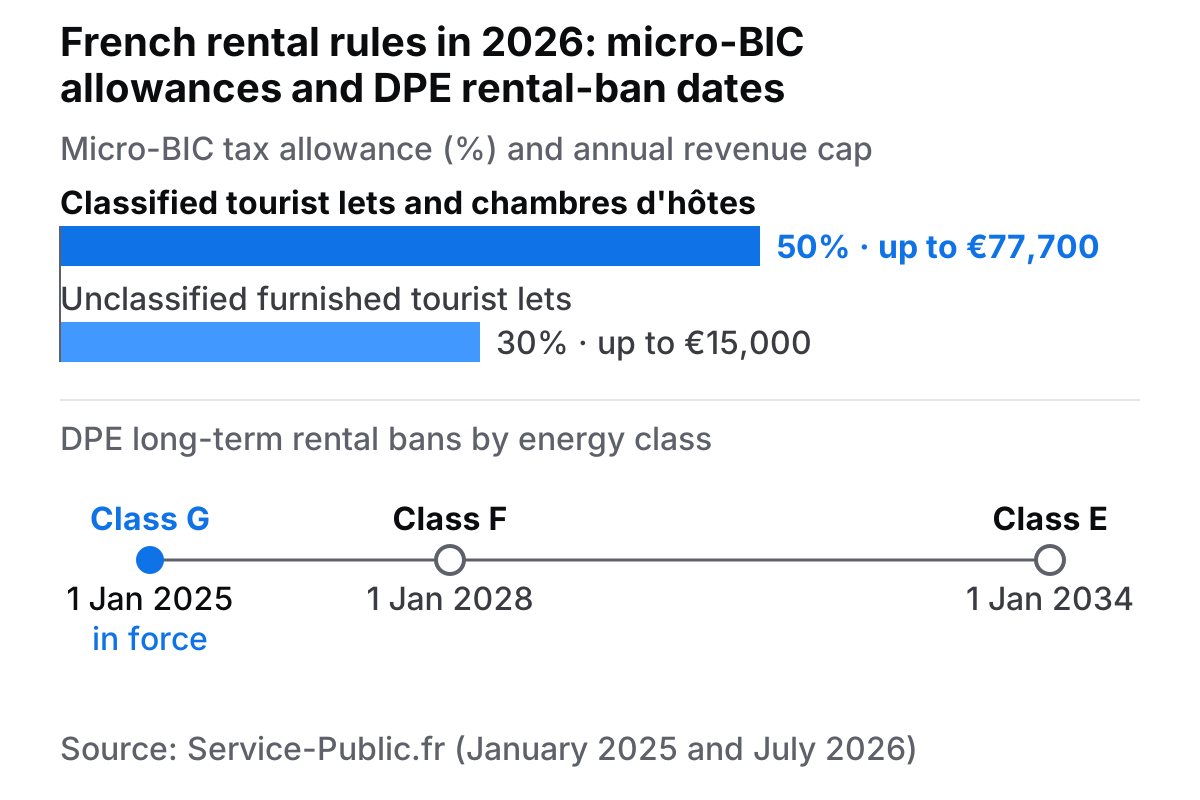
Under the Climate and Resilience Law (Loi Climat et Résilience), property owners face mandatory energy efficiency requirements. Every home for sale or rent requires an official Diagnostic Performance Report (Diagnostic de Performance Énergétique - DPE). The phase-out schedule for residential letting, as published on Service-Public.fr (January 2025), enforces strict prohibitions on new, renewed, or tacitly extended leases:
- DPE Class G: Prohibited from long-term rental since 1 January 2025.
- DPE Class F: Prohibited from 1 January 2028.
- DPE Class E: Prohibited from 1 January 2034.
These rental bans have created discount opportunities for energetic overhaul projects (passoires thermiques). Investors and property managers utilize accurate property valuations and market studies to benchmark post-renovation values and yields before committing capex. See also how rental investment specialists use CASAFARI data in France.
Short-term and tourist rentals face stricter regulation under the Le Meur Law (promulgated 19 November 2024). For income earned from 1 January 2025 and declared in 2026, the tax rules on short-term furnished lets (meublés de tourisme) under the micro-BIC regime have changed, according to Service-Public.fr (July 2026):
- Unclassified short-term lets: Micro-BIC tax allowance reduced to 30% up to an annual revenue cap of €15,000.
- Classified tourist accommodation and chambres d’hôtes: Allowance set at 50% up to an annual revenue cap of €77,700.
- Municipal restrictions: Local councils are empowered to lower the primary-residence short-let ceiling from 120 days to 90 days per calendar year. No single guest may rent a short-term property for more than 90 consecutive days.
What ongoing property taxes and residency rules apply to international owners?
Property ownership in France carries specific recurring local taxes. Annual real estate ownership tax (taxe foncière) applies to all owners, based on cadastral rental values which experienced a national baseline increase of +0.8% in 2026 (following +1.7% in 2025), prior to municipal rate adjustments.
Second-home owners are subject to the second-home residency tax (taxe d’habitation sur les résidences secondaires - THRS). Municipalities located in supply-constrained areas (zones tendues) hold authority to levy a surcharge ranging from 5% to 60% on top of the base tax rate, as detailed by Impots.gouv.fr (September 2026).
Net French real estate wealth exceeding €1,300,000 as of 1 January triggers the Real Estate Wealth Tax (Impôt sur la Fortune Immobilière - IFI). As outlined on Service-Public.fr (January 2026), progressive tax bands apply to the portion of net real estate assets exceeding €800,000:
- €800,001 to €1,300,000: 0.50%
- €1,300,001 to €2,570,000: 0.70%
- €2,570,001 to €5,000,000: 1.00%
- €5,000,001 to €10,000,000: 1.25%
- Above €10,000,000: 1.50%
Upon resale, capital gains (plus-values immobilières) on second homes and investment properties are subject to a 19% flat income tax rate plus social charges (Service-Public.fr, 2026). Income tax on capital gains scales down to full exemption after 22 years of ownership. Standard social charges of 17.2% scale down to full exemption after 30 years. Sellers affiliated with an EU, EEA, Swiss, or UK social security system benefit from a reduced solidarity levy of 7.5% in place of the standard 17.2% social charges.
For non-EU and UK residents, visa-free visits are capped at 90 days within any 180-day period across the Schengen area. Property owners planning stays between 3 and 12 months must secure a long-stay visitor visa (VLS-TS visiteur) prior to travel via the official France-Visas portal and validate it online on the ANEF platform within three months of arrival.
To conduct comprehensive market analysis and discover clean listing data across French departments, sign in to the CASAFARI platform.
Frequently asked questions
What are the notaire fees and transfer taxes when buying a house in France?
Acquisition costs, commonly referred to as notaire fees (frais de notaire), average 7% to 8% of the purchase price for resale properties and 3% to 4% for new-builds, as reported by Notaires de France in February 2026. The vast majority of these fees consist of state taxes rather than administrative expenses, primarily driven by the departmental transfer tax (DMTO), which most departments set at a 5.00% ceiling.
How does the DPE energy rating ban affect buy-to-let investors in France?
Under the Climate and Resilience Law, residential properties rated DPE Class G have been barred from new or renewed long-term leases since 1 January 2025, according to Service-Public.fr. The rental ban will extend to DPE Class F properties on 1 January 2028 and DPE Class E properties on 1 January 2034. Investors must factor necessary energy-efficiency renovations into their pre-acquisition budgets.
What are the new rules for Airbnb and furnished holiday lets in France?
Under the Le Meur Law of 19 November 2024, the micro-BIC tax allowance for unclassified short-term lets is reduced to 30% up to an annual revenue cap of €15,000 for income earned from 2025 and declared in 2026. Classified tourist properties retain a 50% micro-BIC allowance up to €77,700, while local municipalities have authority to cap primary-residence short lets at 90 days per year.
How long can non-EU and UK citizens stay in their French property?
Non-EU citizens, including UK and US nationals, can stay in France without a visa for up to 90 days within any rolling 180-day period across the Schengen area. Property owners wishing to remain in France for between 3 and 12 months per year must apply for a long-stay visitor visa (VLS-TS visiteur) before travelling and validate it online via the ANEF portal within 3 months of arrival.